Aquator's AI layer sits across your entire platform — turning operational data into conversational insights, predictive alerts, and personalised reports that help owners, captains, and fleet managers act faster and smarter.
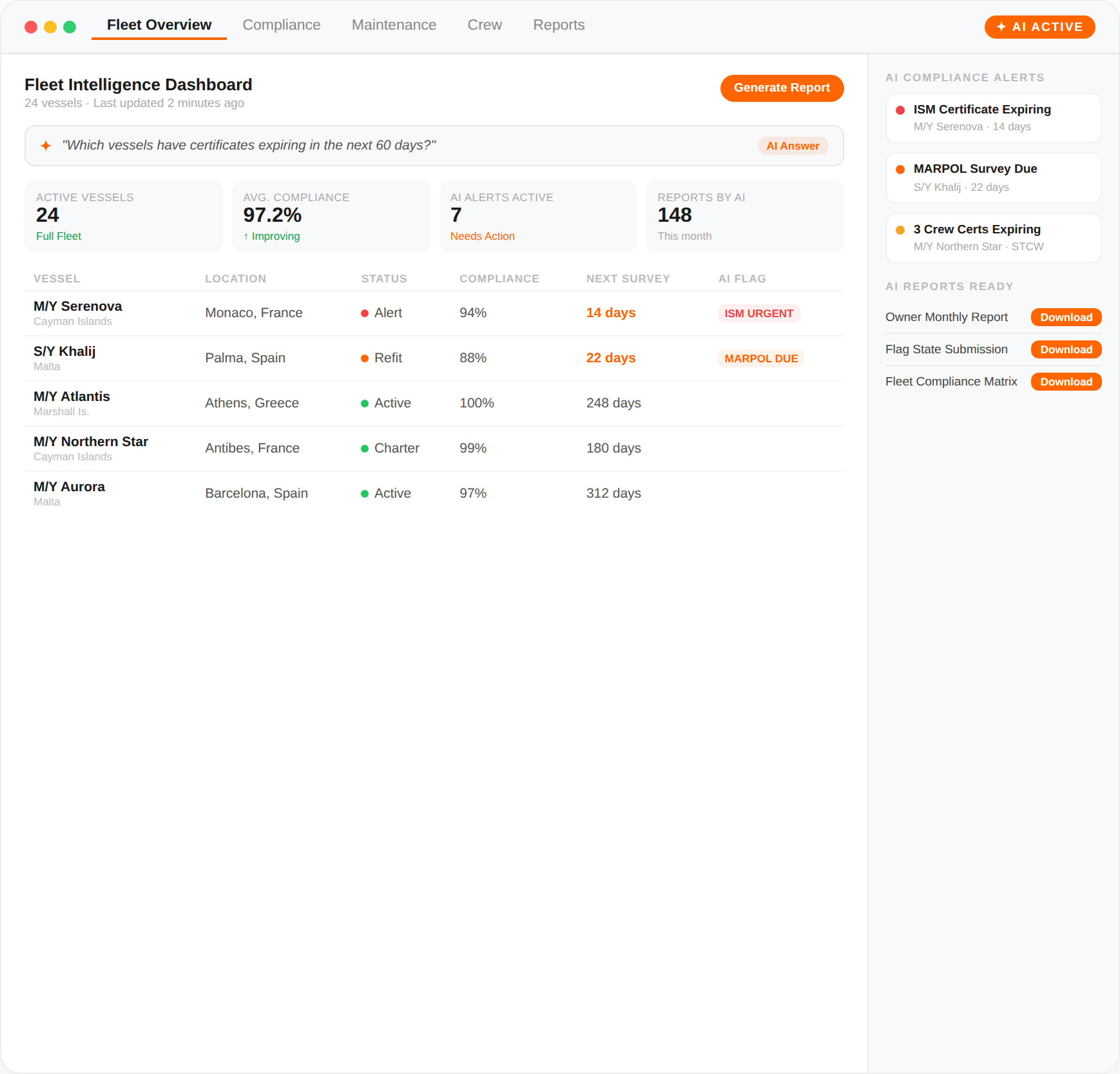
Modern yacht and fleet operations generate thousands of data points daily — certificates expiring, maintenance due, survey dates approaching, crew certifications lapsing. Without intelligence built into the platform, critical signals get missed.
Aquator's custom AI implementation transforms your existing operational data into proactive alerts, natural language answers, and automated report generation — without requiring a separate BI tool or analyst team.
Crew, vessel, and compliance data siloed across systems
Teams find out about issues after they've already escalated
Hours spent building reports that could be generated instantly
Answering simple questions requires digging through multiple screens
Aquator's AI is not a bolt-on feature — it is custom-built into your data architecture, trained on maritime operations, and delivered through interfaces your team already uses.
All vessel, crew, compliance, and maintenance data flows into a single structured layer — connected across your fleet in real time.
Maritime-specific AI models are trained on your operational data — understanding your fleet, your workflows, and your reporting needs.
Ask questions in plain language. The AI queries your live data and returns accurate, contextual answers — no dashboards to navigate.
Tailored reports generated automatically for owners, flag states, managers, and crew — formatted for each audience, on demand.
Core AI Capabilities
Six purpose-built AI modules that work together across your fleet — each one customised to your specific operational context and reporting needs.
Monitors certificate expiry timelines, survey due dates, and regulatory milestones across every vessel. Surfaces risks weeks before they become critical — with prioritised action lists for your team.
Analyses historical maintenance patterns, open work orders, and vessel usage to predict upcoming requirements. Recommends optimal refit windows and flags deferred items before they escalate.
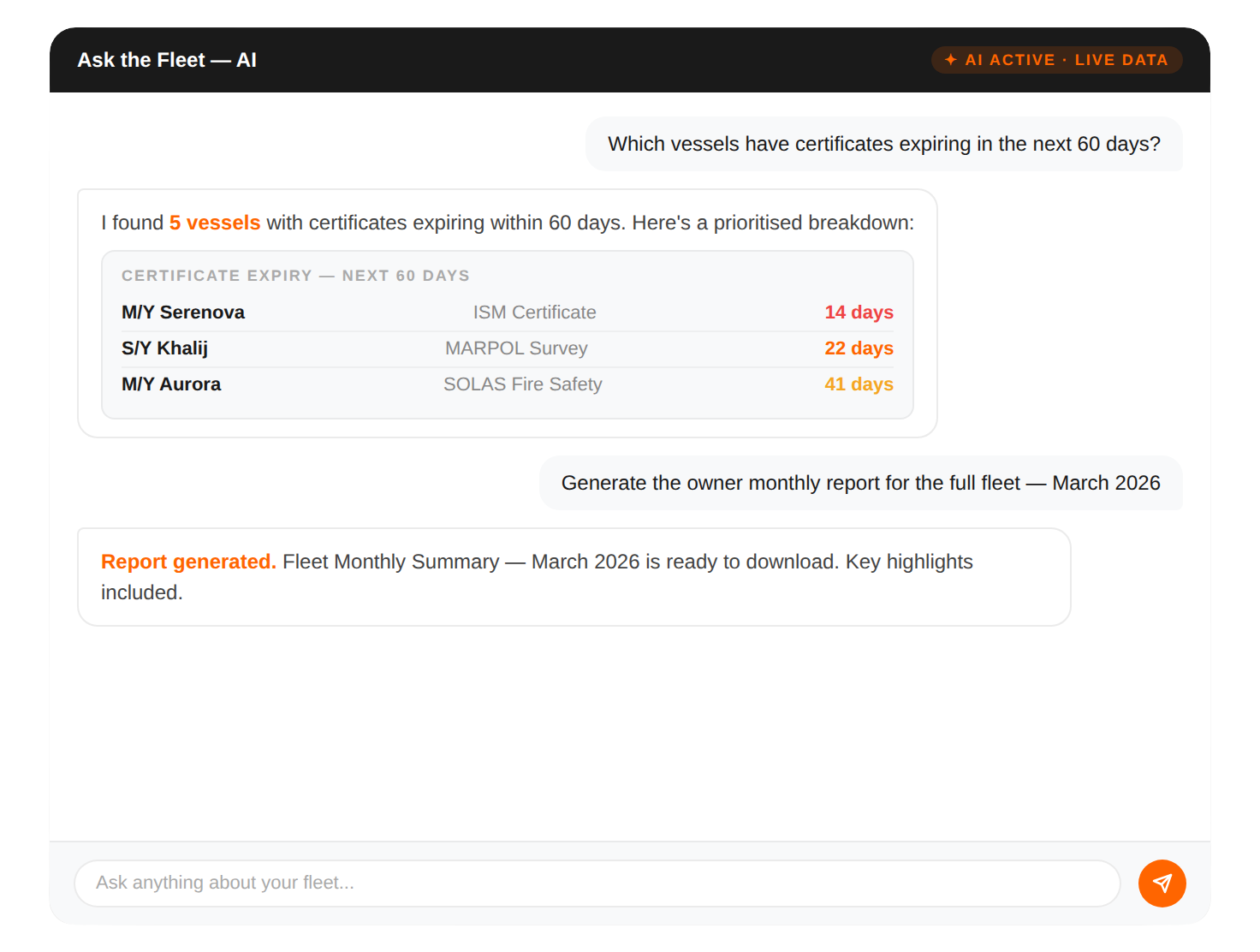
Ask your fleet any question in plain English. "Which vessels have surveys due in the next 60 days?" or "What is the compliance status of M/Y Serenova?" — answered instantly from live data.
Extracts, classifies, and indexes thousands of maritime documents — certificates, manuals, logbooks, surveys — making them searchable, verifiable, and cross-referenced automatically.
Aggregates operational data across your entire fleet to identify performance trends, utilisation patterns, and cost anomalies — with AI-generated commentary explaining the findings.
Continuously evaluates crew certification status, contract timelines, rest hour compliance, and watchkeeping records — automatically identifying crew risk across your entire roster.
Aquator's AI interface is embedded directly into the platform — no separate tools, no switching context. Type a question in plain language and receive a precise, data-backed answer drawn from your live operational records.
Whether you are checking compliance status from a marina, reviewing crew certifications before departure, or briefing an owner on fleet performance — the AI brings your data to you.
Data Layer & Integration
The Aquator AI layer connects to every data source across your fleet — internal modules, third-party systems, and external registries — building a single intelligence layer your entire organisation can query.
Custom-trained maritime models processing your live operational data in real time
Personalised Reports
Aquator's AI generates tailored reports for each audience — formatted, branded, and ready to share. No manual compilation, no copy-pasting across spreadsheets.
Executive-level summaries of fleet performance, compliance status, and expenditure — formatted for owner review and automatically distributed on schedule.
Operational dashboards and cross-fleet summaries that give fleet managers a complete picture — with AI-identified priorities and actionable risk flags.
Regulatory submissions and statutory documentation assembled automatically — accurate, timestamped, and formatted to flag state requirements for each vessel.
Custom Development & Implementation
Aquator AI is not a generic tool — it is custom-implemented for your specific fleet composition, reporting requirements, and operational workflows. Our implementation team handles everything from data mapping to go-live.
Custom Development & Implementation
We audit your data sources, fleet structure, and reporting requirements.
Connecting your platform data into the unified AI-ready layer.
Training models on your data, configuring conversational interface and reports.
Full deployment with ongoing tuning based on team usage and feedback.
Why Custom Matters
Data Integrations
Aquator AI connects to your existing data sources, registries, and third-party platforms — building a comprehensive intelligence layer without replacing the tools your team already uses.
Real-time position and voyage data integrated directly
Certificate verification against official flag authority databases
Lloyd's Register, DNV, Bureau Veritas survey data
AI reads incoming documents and auto-classifies into records
Budget, expenditure, and cost data from your finance tools
Booking calendars, charter agreements, and utilisation data
Parts ordering, inventory, and supplier communication history
Bespoke integrations built to your specific data architecture
Aquator AI is built for the maritime industry's strictest data security requirements — your operational data never leaves your environment and is never used to train models for other clients.
Your fleet data remains in your dedicated environment. No co-mingling with other operators' data. Full control over where your data lives and who can access it.
AI models trained on your data are exclusive to your organisation. Your operational intelligence never trains models for any other client or shared system.
Every AI output is traceable to its source data. Full audit logs of all queries, reports generated, and data accessed — essential for flag state and regulatory accountability.
Talk to our team about a custom AI implementation for your vessel portfolio — from discovery to go-live in as little as 9 weeks.